
 0
0


- Home
- Blog
- Product Insights
- Pull Out Pantry Rack Installation Essentials: Size, Load Capacity & Slide System Details
Pull Out Pantry Rack Installation Essentials: Size, Load Capacity & Slide System Details
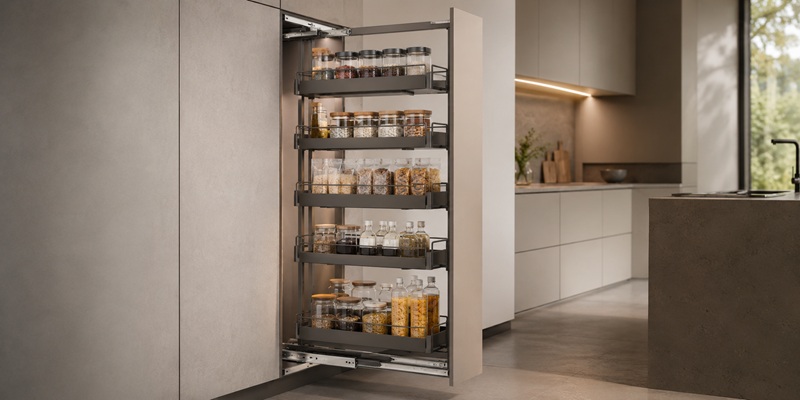
For kitchen cabinet manufacturers, system cabinet providers, interior designers, and hardware distributors, the stability of a pull out pantry rack after installation is often scrutinized during actual use. If the hardware's load capacity is insufficient, issues such as shelf deformation, unsmooth sliding, or even jamming may occur. This not only affects the user experience but also leads to customer complaints and subsequent maintenance costs. This article will cover everything from pull out pantry rack specification selection and installation details to daily maintenance, helping you summarize key points that are easily overlooked in practice.
Pull Out Pantry Rack vs Shelving
When planning a kitchen or storage space, the difference between a pull out pantry rack and traditional shelving lies not just in appearance, but in long-term convenience and maintenance costs. A pull out pantry rack can be pulled out, making items clear at a glance. It is especially suitable for deep or tall cabinets, eliminating the need to bend over and search or move everything out from the front at the same time, pull-out systems can maximize cabinet space utilization, achieving nearly 100% storage efficiency. In contrast, shelving has a simple structure, low cost, and fast installation, but in deeper cabinets, items in the back are easily ignored or left piled up for long periods, making organization more time-consuming.
〈Extended Reading: Complete Guide to Drawer Slides: Types, Sizes, and Selection Tips〉
〈Extended Reading: Top Mount Drawer Slides: Design, Installation, and Maintenance Guide〉
Choosing Between Pull-Out Racks and Shelving
| Comparison Items | Pull Out Pantry Rack | Fixed Shelving |
|---|---|---|
| Space Efficiency | Can be fully pulled out for use; no waste of deep cabinet space | Deep space is easily left idle or ignored |
| Ease of Access | Equipped with a sliding mechanism, no need to bend or search; items are clear at a glance | Requires reaching in or moving front items, making it less intuitive |
| Installation Complexity | Requires slide rails and hardware, with higher precision requirements | Simple structure, fast and easy installation |
| Maintenance & Complaints | Poor quality hardware can lead to sticking and complaints; high-quality slide rails are durable | No mechanical failure issues, but lower practicality |
How to Choose the Right Pull Out Pantry Rack: Styles & Materials
Pull out pantry racks are designed in various styles to meet different storage needs, such as single-tier pull-out baskets for base cabinets, multi-tier storage systems for tall cabinets, or narrow pull-out hardware specifically for storing seasonings. Each corresponds to a different usage scenario. When choosing, besides the style configuration, the material is the key factor affecting durability and smoothness. The following summarizes common material types:
Steel Wire
Steel wire has a lightweight structure and good ventilation, making stored items clear at a glance and easy to access and organize. The surface is usually treated with electroplating or painting to enhance rust resistance and durability, making it suitable for daily kitchen storage. However, if exposed to a humid environment for a long time, corrosion may still occur once the coating wears off, requiring regular inspection and maintenance.
Stainless Steel
Stainless steel possesses excellent moisture, corrosion, and heat resistance, making it rust-resistant and ideal for high-humidity environments like kitchens. The overall structure is stable with good load-bearing capacity and does not easily deform over time. Its appearance is clean and sleek with a modern style, suitable for various kitchen designs. However, compared to other materials, the cost is usually higher, and the initial investment will increase accordingly.
Wood / Walnut Wood
Wood provides a warm and natural feel, enhancing the texture of a space, and is suitable for those who value home style. Walnut wood, for example, has a fine and beautiful grain with good hardness and stability, adding a sense of luxury to cabinets. However, wood itself is sensitive to moisture; if not properly maintained, there is a risk of deformation or mold over time. Therefore, special attention to waterproofing and daily cleaning is required during use.
Plastic
Plastic materials are lightweight and affordable, and they offer excellent water resistance and easy cleaning, making them highly practical for storing lighter items. Because they are inherently lightweight, moving or adjusting their position is also very easy, providing high flexibility for renters or users with limited budgets. However, relatively speaking, the load-bearing capacity and durability of plastic are weaker; it is not recommended to place heavy objects on them for long periods or subject them to high-load use to avoid deformation or damage.
Pull Out Pantry Rack Applications
Pull out pantry rack applications are quite flexible, allowing installation methods to be adjusted according to different cabinet sizes and spatial configurations. Through the slide-out design, stored contents can be presented directly before your eyes, which not only makes retrieving items more convenient but also makes categorization and organization more intuitive.
- Tall Units: Commonly used in tall vertical cabinets as primary storage or food pantry spaces, allowing the entire set to be pulled out for easy access and categorized management.
- Base Cabinets: Suitable for installation in cabinets below countertops, making daily essentials or cookware more accessible; the pull out design reduces the inconvenience of bending over and rummaging, making use smoother and more efficient.
- Corner Spaces: Through specialized corner designs, cabinet dead zones that were previously hard to reach or left idle are reclaimed, turning corner spaces into practical storage areas.
- Drawers: These can also be extended for use in drawer systems, using partitioned designs to arrange items more methodically, reducing clutter and making daily use and organization easier.
- Pantry & Utility Rooms: Implementing a pull out pantry racks in storage rooms or utility spaces allows for the centralized storage of food, cleaning supplies, and backups; paired with a slide-out design, the retrieval and organization process becomes much smoother.
Installation & Maintenance Guide for Pull Out Pantry Racks
Before installing a pull out pantry rack, preliminary size measurement and spatial planning are critical; this will affect whether the subsequent pulling and pushing are smooth and can also prevent issues such as door panel interference or restricted slide rail operation. At the same time, correct usage and daily maintenance methods will also influence the overall smoothness and service life.
Installation Measurement Guide
Before installation, it is necessary to confirm the net width, net depth, and net height of the cabinet interior, and reserve space required for the operation of slide rails and hardware. Additionally, check the door opening angle and hinge positions to ensure that the pull out pantry rack, when fully extended, will not collide with the door panel or other hardware.
Check Load Limits to Prevent Overloading
When in use, weight should be distributed according to the design load capacity, avoiding the concentration of excessively heavy items on a single shelf or the outer edges. It is recommended to place heavy items on the bottom and distribute lighter items on the upper levels to ensure more even force distribution. This helps maintain slide stability and reduces the risk of long-term deformation or damage.
Keep Tracks Clean and Running Smoothly
It is recommended to regularly clean dust and debris from the slide rails to prevent foreign objects from affecting the ball bearing operation and causing sticking. Avoid using strong acids or corrosive cleaners during cleaning to prevent damage to the surface anti-rust coating, which could affect the durability and appearance of the pull out pantry rack.
Pull Out Pantry Racks FAQs
What Is the Load Capacity of Pull-Out Pantry Racks?
The load capacity of a pull out pantry rack primarily varies depending on the slide grade, hardware specifications, and overall structural design. If there are special storage requirements, it is recommended to consult a manufacturer with engineering design capabilities for a comprehensive evaluation to ensure safety and stability.
How to Fix a Sticking Pull Out Pantry Rack?
When a pull out pantry rack sticks or does not pull smoothly, the first step is to check if there are dust or foreign objects blocking the slides, then confirm whether the cabinet has shifted due to thermal expansion and contraction or long-term load deformation, affecting its verticality. Also, check if there is interference between the door panel and the hardware to avoid affecting the pull-out travel. Finally, test the slide ball bearings for wear or unsmooth operation to evaluate whether replacement or adjustment is needed.
Conclusion
Pull out pantry racks, through efficient storage and slide hardware design, effectively improve space utilization and the convenience of daily access, while also making subsequent maintenance and adjustment simpler. They are a storage solution that combines practicality with long-term stability. Sun Chain provides complete system configurations from tall cabinets and base cabinets to corner spaces, and further offers engineering support, including structural design assistance, customized load solutions, and OEM project support, helping to create more efficient and reliable storage applications in various scenarios. Contact us to learn more.


Sun Chain
Sun Chain is a Taiwan-based solution provider with two factories specializing in furniture & building hardware and sliding systems, including industrial and super heavy-duty slides.


Article Classification
Recent Articles
- Are Kitchen Pull-Out Baskets Worth It? Ultimate Guide to Uses and Selection Tips
- Base Cabinet Pull-Out: The Hidden Upgrade Behind Modern Kitchen Storage
- The Applications of Heavy-Duty Lockable Drawer Slides for a Safer Workspace!
- What Are Telescopic Slides? The Ultimate Guide to Types, Capacities, and Applications
- How to Choose and Maintain Pull-Out Wine Racks for Your Collection