
 0
0


- Home
- Blog
- Product Insights
- Magic Corner Cabinet: Turn Wasted Kitchen Corners Into Usable Storage Space
Magic Corner Cabinet: Turn Wasted Kitchen Corners Into Usable Storage Space
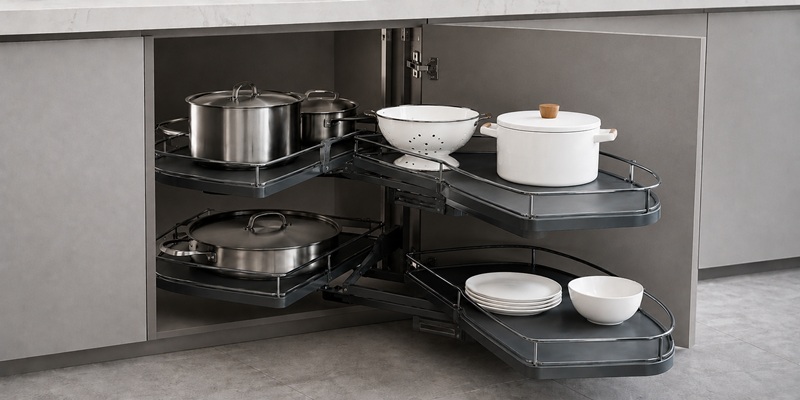
In kitchen storage, the most easily overlooked space is not the countertop or drawers, but that visible yet hard-to-reach corner blind spot. Especially in L-shaped kitchens, this blind corner is one of the most underused areas — based on Sun Chain's engineering experience, it often accounts for roughly 25–35% of the total base cabinet storage. By bringing these hidden areas to the front, a magic corner cabinet can raise blind-corner utilization from under 30% to almost fully usable. Next, we will take you through a quick introduction to what a magic corner cabinet is, common types, and key points often overlooked during selection and installation.
〈Extended Reading: Complete Guide to Drawer Slides: Types, Sizes, and Selection Tips〉
What is a Magic Corner Cabinet?
A magic corner cabinet is a type of corner storage hardware specifically designed for kitchen blind corner base cabinets. Traditional blind corner cabinets only have fixed shelves inside, where items easily get piled deep in the back. When using them, one often needs to bend down and reach far inside to find anything, resulting in a lot of space being left idle and wasted.
Magic corner cabinets utilize a linked pull-out structural design. When the door is opened, the internal baskets or trays are automatically brought to the outside of the cabinet, pulling items originally hidden deep in the corner directly in front of you for more intuitive access. This design significantly improves blind corner storage efficiency and allows deep spaces to truly be utilized.
〈Extended Reading: The Strategic Edge of Two-Way Drawer Slides: Beyond Conventional Storage〉
Available Types of Magic Corner Cabinet Systems
Because of different cabinet designs and door opening directions, kitchen corners easily form dead spaces that are difficult to use, so different hardware systems are paired to improve storage efficiency. Next, let's look at several common types of magic corner cabinets:
Pull-Out Shelves
Pull-Out Shelves are one of the most typical styles of magic corner cabinets. By using slide rails combined with a linked metal frame design, the entire set of internal shelves can be pulled out. When the door is opened, the front and rear trays are simultaneously brought to the outside, making them suitable for medium to large items such as cookware, dishes, and small appliances. You can easily access items deep inside without bending over or reaching blindly.
Lazy Susan Style
Lazy Susan is another common corner storage design, primarily utilizing a rotating turntable structure. With a gentle push, it rotates to retrieve items, allowing items at different angles to be reached. It is commonly seen in kidney-shaped corner cabinets, which have a simple structure and relatively affordable price, but the space utilization of the very corners is not as good as
Left / Right Handed
Left / Right Handed designs can be adjusted according to the kitchen workflow and door opening direction. The magic corner cabinet is available in both left-opening and right-opening specifications, allowing users to choose the most convenient direction based on the actual space. Modern modular designs support cabinet widths of 400mm, 450mm, and 600mm.
〈Recommended Products: Corner Solutions〉
Smart Magic Corner Cabinet Ideas
Double-tier Storage
The double-tier design makes access more intuitive. The bottom layer is suitable for heavy cookware, soup pots, or small appliances (such as ovens and mixers), while the upper layer can use adjustable shelves to store seasonings, dry goods, or small dishes. With the pull-out structure of the magic corner cabinet, items originally stored deep in the corner can be easily accessed.
Soft-Close / Soft & Silent
A magic corner cabinet with a soft-close design will automatically decelerate and pull in when pushed back, reducing collision noise and wear on hardware components, making operation
Blind Corner Cabinet
Magic corner cabinets are primarily used in the right-angle corner spaces of L-shaped or U-shaped kitchens. Through a special linkage design, corners that were previously difficult to utilize are transformed into storage spaces that are both visible and accessible, ensuring the corner is no longer just an idle corner.
Smart Space-Saving Tips
Some detailed adjustments can be made to the storage configuration, such as using side racks for pot lids, and using transparent jars with labels for seasonings to make access more intuitive. It is recommended to place small appliances on the bottom layer and dishes on the upper layer, which aligns with the frequency of use. By utilizing these tips, the storage efficiency of the magic corner cabinet will be even higher.
〈Extended Reading: Top Mount Drawer Slides: Design, Installation, and Maintenance Guide〉
Sizing and Selection for Magic Corner Cabinets
Before purchasing a magic corner cabinet, you must first confirm the internal net dimensions of the cabinet, including net width, net depth, and net height. Different brands have their own applicable ranges for door width and installation space. If the dimensions are not aligned, it is easy to encounter situations where it cannot be installed or becomes stuck during use. Additionally, the internal height of the cabinet should be carefully noted, as some systems require a certain height to operate normally. Furthermore, often-overlooked factors such as water pipe locations, hinge movement ranges, or back panel protrusions must be accounted for in advance; otherwise, the unit may easily get stuck when pulled out.
How to DIY Your Magic Corner Cabinet Installation
Corner hardware requires high installation precision, but the design and construction methods of different brands are all different. Special attention must be paid to alignment and adjustment during installation to ensure subsequent use is smooth and fluid.
Aligning Rails and Dampers for Smooth Operation
Check Door Opening Angle Before Installation
Before installing the magic corner cabinet, you must first confirm the opening angle of the door panel and pair it with suitable wide-angle hinges to prevent the door panel and the pull-out structure from interfering with each other during use, which could cause jamming or uneven operation.
Magic Corner Cabinet FAQs
Can Magic Corner Cabinets Be Installed in Existing Kitchens?
Yes. However, the prerequisite is to first confirm whether the site conditions are suitable. Factors such as the internal net width, depth, and height of the cabinet all need to be accurately measured, and the door opening size must also be checked for compatibility. Additionally, if there are water pipes, hinges, or other protruding structures inside, you must check whether they will interfere with the hardware's operation to avoid subsequent jamming or installation failure.
Why Does a Magic Corner Cabinet Feel Stiff or Get Stuck?
If a magic corner cabinet experiences jamming or rough, inconsistent movement, it is often associated with installation alignment. For example, if the tracks are not level or the hole positions are misaligned, sliding performance will be affected. Another common cause is uneven weight distribution of stored items, which over time causes uneven stress on the base and affects sliding smoothness. If jamming occurs, it is recommended to remove some items to reduce weight and then re-check the levelness of the slide rails; this usually restores normal use.
Conclusion


Sun Chain
Sun Chain is a Taiwan-based solution provider with two factories specializing in furniture & building hardware and sliding systems, including industrial and super heavy-duty slides.


Article Classification
Recent Articles
- Are Kitchen Pull-Out Baskets Worth It? Ultimate Guide to Uses and Selection Tips
- Base Cabinet Pull-Out: The Hidden Upgrade Behind Modern Kitchen Storage
- The Applications of Heavy-Duty Lockable Drawer Slides for a Safer Workspace!
- What Are Telescopic Slides? The Ultimate Guide to Types, Capacities, and Applications
- How to Choose and Maintain Pull-Out Wine Racks for Your Collection