
 0
0


- Home
- Blog
- Applications
- The Practicality and Convenience of Corner Pantry Lazy Susans
The Practicality and Convenience of Corner Pantry Lazy Susans
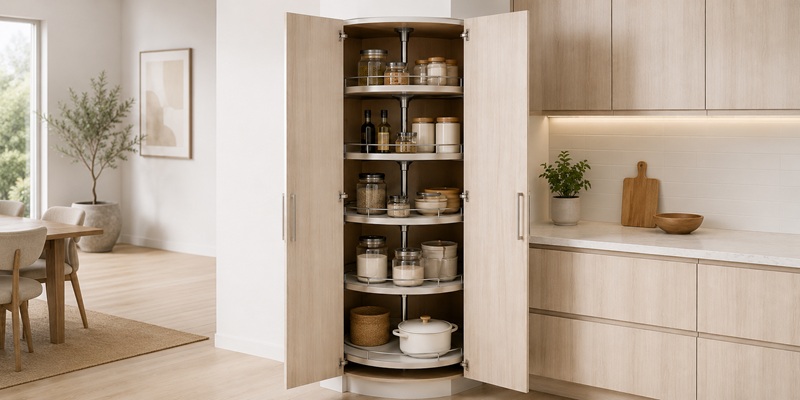
Many kitchens and pantries feature L-shaped corner cabinets. While they appear to offer ample space, the deep blind corners are often difficult to reach, frequently becoming cluttered with expired ingredients or unused items. To solve this problem, installing a corner pantry Lazy Susan is a highly practical choice. Through a simple rotating design, items hidden deep inside can be brought to the front, making everyday access more convenient. This article explores the various advantages and common styles of corner pantry Lazy Susans, as well as practical tips for selection and installation, helping you make the most of every inch of your kitchen space.
Why You Need a Corner Pantry Lazy Susan for Better Space Utilization
In L-shaped or deep corner cabinets, traditional fixed shelves often leave the deepest areas unused because they are hard to reach, leading people to simply leave it empty. A corner pantry Lazy Susan improves this situation by transforming previously unusable areas into practical storage space, keeping kitchen countertops tidy and making daily cooking routines smoother.
〈Extended Reading: Magic Corner Cabinet: Turn Wasted Kitchen Corners Into Usable Storage Space〉
Solving Blind Corner Access Difficulties
The biggest problem with corner cabinets is that items placed deep inside are hard to see and difficult to reach; finding something might even require leaning entirely into the cabinet to search. The rotating base design of a corner pantry Lazy Susan simplifies the act of searching in the dark into a gentle turn, automatically bringing items stored deep inside to the front. This change makes kitchen workflow smoother, allowing faster access to stored items while significantly improving the usability limitations commonly found in traditional corner cabinets.
〈Extended Reading: Pull-Out Basket Selection Guide: Balancing Functionality, Durability, and Cabinet Organization〉
Maximizing Space Efficiency
For kitchens with limited space, especially in small living spaces, whether corner space can be effectively utilized significantly impacts overall storage capacity, and efficient use of available storage space becomes increasingly important. A corner pantry Lazy Susan transforms corners that could previously only hold a few items or easily became blind spots into highly efficient storage areas. Even in the deepest part of a corner, the rotating structure helps make previously underutilized corner areas more functional for everyday storage.
〈Extended Reading: Pull Out Pantry Rack Installation Essentials: Size, Load Capacity & Slide System Details〉
Making Storage Retrieval Easier
In addition to significantly increasing storage space, a corner pantry Lazy Susan is also ideal for improving kitchen organization. Because items can be arranged by category, you no longer need to rummage through cabinets to find what you need, making retrieval quite intuitive. It also reduces duplicate purchases or the risk of items expiring unnoticed. Through the clear visibility provided by the rotating tray, you can keep track of ingredients in the pantry at any time, making the management of daily supplies simpler and easier.
〈Extended Reading: Pull-Out Storage Explained: From Everyday Use to Custom OEM Solutions〉
Trending Corner Pantry Lazy Susan Styles
There are many different specifications and shapes of corner pantry Lazy Susans on the market, mainly corresponding to different cabinet structures and door designs. Below are four common corner pantry Lazy Susan structures.
Corner Pantry Lazy Susan 1. D-Shape
The D-shaped corner pantry Lazy Susan has a semicircular shape and can fit snugly against the corner structure of the cabinet. This D-shaped design is typically used with standard hinged door designs; when the door is opened, the flat side of the rotating tray aligns with the doorway, so it does not interfere with the opening and closing of the door panel. It is suitable for installation in standard-depth wall or base cabinets for storing various bottles, jars, and seasonings. The advantages of the D-shaped design are its simple structure, relatively easy installation, and smooth and stable rotation.
Corner Pantry Lazy Susan 2. Kidney-Shaped
The kidney-shaped corner pantry Lazy Susan is a very common corner style, featuring a curved, oval-like shape with a concave notch. This concave design is primarily intended to avoid the corner of L-shaped corner cabinets. When the door is opened and the tray is rotated, the kidney-shaped design balances storage capacity with convenience during rotation, preserving better movement space without getting caught on the cabinet doors on either side. It is suitable for use in traditional L-shaped base cabinets for storing slightly larger cookware or food packaging.
Corner Pantry Lazy Susan 3. Round
The round Lazy Susan has the most straightforward design, with no notches, making it visually clean and sleek. The round design also rotates more predictably because the radius is fixed; as long as there is enough space inside the cabinet, there are almost no issues with getting stuck. It is suitable for users who want to quickly organize corner spaces. When storing daily dry goods, canned food, or even seasonings, the round Lazy Susan provides smooth access to items from all directions—just a gentle turn allows you to reach items in any direction.
Corner Pantry Lazy Susan 4. Pie-cut
The pie-cut style is a more specialized corner design, shaped like a round tray with a section removed. This design typically fixes the L-shaped cabinet door directly to the notch of the Lazy Susan; when you push the door, the entire Lazy Susan rotates into the cabinet along with the door. The advantage of the pie-cut design is that there is no need to open the door separately before reaching in to rotate the tray, making the movement seamless. It is suitable for kitchen spaces where a perfectly consistent appearance with the cabinetry is desired and fewer operating steps are preferred.
Corner Pantry Lazy Susan Weight Capacity
When choosing a corner pantry Lazy Susan, be sure to pay attention to the product's weight capacity, material thickness, number of tiers, and bottom structural design. If you plan to store heavy cans, large ceramic pots, or large quantities of dry goods long-term, you must specifically verify the strength of the central pivot and support frame.
Weight capacity plays an important role in long-term durability and overall rotational stability. If the product's structure is not solid enough, continuous heavy loading over long periods may contribute to tray deformation, reduced rotational stability, uneven movement over time, or even a misaligned support shaft. Therefore, when planning kitchen storage, you should first list the types and approximate weights of items to be placed in the corner cabinet, and then select a corner pantry Lazy Susan that meets the specified load rating based on actual storage needs.
Sizing Your Corner Pantry Lazy Susan
Measure the Internal Cabinet Width
Before installing a corner pantry Lazy Susan, the most important step is to accurately measure the internal length and width of the cabinet to ensure the purchased Lazy Susan can be successfully placed inside. It is recommended to check for interference from hinges, water pipes, or other protruding woodwork during measurement. If the dimensions are too tight, the tray may fail to rotate, get stuck on the door panel, or simply not fit during installation.
Ensure Adequate Clearance Height
In addition to width and depth, the internal height of the cabinet is equally important. For a double-layer or multi-layer corner pantry Lazy Susan, you must confirm that there is sufficient vertical space between layers. Especially when preparing to store tall soy sauce bottles, large oil bottles, or large-capacity packaged foods, it is especially important to leave enough vertical clearance to prevent items from getting stuck against the upper shelf once they are placed inside.
Check Door Clearance to Prevent Rotation Blockage
Some corner cabinets may seem to have enough internal space when measured, but after actual installation, the opening angle of the door panel may affect the operation of the Lazy Susan. If the hinges or the edge of the door panel touch the rotating structure or obstruct the rotation path after the door is opened, usability will be greatly reduced. Therefore, when measuring, you must consider both the fully open and half-open states of the door panel.
Installation Tips and Maintenance
Successful installation depends mainly on whether the initial size measurements are correct and whether the selected style is suitable for the type of cabinet in your home. Common installation errors include: failing to subtract the thickness occupied by hinges during measurement, not reserving clearance for door rotation, and failing to securely tighten the base screws of the central pivot, causing wobbling during rotation.
In terms of daily maintenance, it is necessary to keep the interior of the corner cabinet dry and regularly clean the tracks, brackets, and rotating parts. Kitchen environments are often exposed to grease; if not cleaned for a long time, grease and dust can easily accumulate in the rotating bearings, causing the tray to stick or rotate unevenly. It is recommended to perform a simple wipe-down of the bearings every few months to keep the Lazy Susan rotating smoothly.
〈Extended Reading: Top Mount Drawer Slides: Design, Installation, and Maintenance Guide〉
Corner Pantry Lazy Susan FAQs
Q1. Is a Corner Pantry Lazy Susan Suitable for Storing Pots and Pans?
It is not recommended to place pans with long handles on a basic corner pantry Lazy Susan, because the cookware is bulky and protruding handles can easily get stuck against the cabinet walls during rotation. However, if you install a corner pantry Lazy Susan with a higher load capacity and a large enough surface area, it can be used to store stew pots or soup pots. If you are placing extremely heavy cookware such as cast iron pots, be sure to check the product's load rating to avoid damaging the bearings.
Q2. Can a Corner Pantry Lazy Susan Be Installed in Upper Cabinets?
Yes, it can. As long as the internal structure and height conditions of the cabinet allow, the upper cabinets can also be fitted with small-sized corner pantry Lazy Susans. This helps you easily reach pepper shakers, tea canisters, or small spice bottles placed high and deep inside, saving you the trouble of using a step stool.
Q3. Does a Corner Pantry Lazy Susan Require Professional Installation?
If it is a simple single-layer or double-layer D-shaped or circular model, many users with DIY experience can install it themselves using a simple screwdriver, which also helps reduce professional installation costs. However, if it is a Pie-cut model with extremely high load capacity that needs to be linked with the door panel, or a complex design requiring precise alignment, it is generally recommended to have it installed by a professional to ensure that it can be smoothly opened and closed during use.
Q4. Does a Corner Pantry Lazy Susan Come with a Warranty?
Whether there is a warranty usually depends on the brand and the specific product series specifications. Warranty terms and after-sales support vary based on product models and project requirements, giving you more peace of mind during long-term use. However, the actual warranty coverage is ultimately determined by whether the product is used according to the manufacturer’s instructions.
Smart Storage Solutions with Sun Chain Corner Pantry Lazy Susans
If you are looking for professional and durable corner storage products, Sun Chain provides a range of corner pantry Lazy Susan solutions designed for different storage requirements. Sun Chain does more than manufacture Lazy Susans; it considers everything from cabinet dimensions and daily access habits to the load-bearing requirements of stored items. Sun Chain offers a variety of specifications to ensure stable hardware structures and smooth rotation. Its product designs are tailored to real-life kitchen needs, helping you easily solve storage challenges in deep corners and create a more efficient cooking space.
Conclusion
The corner pantry Lazy Susan is a storage tool that combines practicality with space efficiency. It not only solves the problem of accessing items in deep corners but also helps improve accessibility while making corner storage space more efficient and practical for everyday use. Whether storing spices, dry goods, or cookware, the rotating design significantly enhances daily convenience. If you are planning to renovate your kitchen, consider the professional corner pantry Lazy Susan solutions provided by Sun Chain to find the most suitable configuration for your home cabinets. Click to learn more and make kitchen storage easier!


Sun Chain
Sun Chain is a Taiwan-based solution provider with two factories specializing in furniture & building hardware and sliding systems, including industrial and super heavy-duty slides.


Article Classification
Recent Articles
- How a Spice Rack Pull Out Transforms Your Kitchen Storage and Maximizes Space
- Pull Out Cabinet Organizer: How to Maximize Every Inch of Cabinet Space
- The Practicality and Convenience of Corner Pantry Lazy Susans
- Pull-Out Storage Explained: From Everyday Use to Custom OEM Solutions
- The Strategic Edge of Two-Way Drawer Slides: Beyond Conventional Storage