
 0


Why Corrosion Resistance Matters for Telescopic Slides in Commercial Vehicles ?
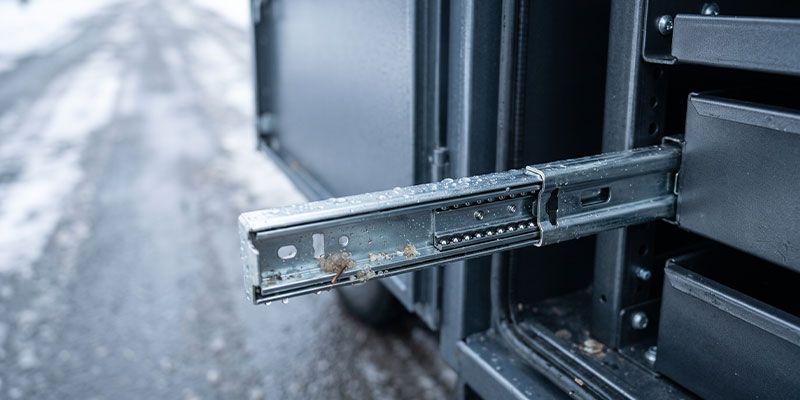
Humidity, condensation, temperature fluctuations and exposure to road salt can all contribute to corrosion.
The concern is not simply whether rust appears. It is how corrosion may affect the components responsible for smooth and consistent movement.
When corrosion develops on critical surfaces, including the rails and ball-bearing raceways, it can increase friction, affect rolling performance and compromise the slide’s long-term functionality.
For vehicle applications, corrosion resistance should therefore be considered early in the slide selection process.
Where Does Corrosion Resistance Matter Most?
Corrosion risks vary depending on where and how a vehicle operates.Cold Climates — Northern Europe and North America
In Northern Europe, Canada and the northern United States, road salt and de-icing chemicals used during winter can create highly corrosive conditions. Slides installed in exterior storage compartments or areas exposed to road spray may face increased corrosion risks, particularly when salt deposits and moisture accumulate over time.
Coastal and Marine Environments
In coastal regions, airborne salt, humidity and condensation can accelerate corrosion. This is particularly relevant for service vehicles operating near ports, coastal infrastructure and industrial facilities, where equipment storage systems may experience prolonged exposure to moisture and salt-laden air.
Tropical and High-Humidity Regions
In parts of Southeast Asia and India, prolonged humidity, heavy rainfall and condensation present different corrosion challenges. Even without direct exposure to road salt, continuous moisture and repeated wet-dry cycles can increase the risk of corrosion on metal components.
These environmental conditions are particularly relevant to applications such as:
• Fire & Rescue Vehicles: Equipment drawers exposed to outdoor conditions, moisture and frequent operation.
• Service Vans & Utility Vehicles: Tool storage systems operated regularly under changing weather conditions.
• Truck Storage Systems: Exterior compartments exposed to road spray, salt and moisture.
• RV & Overland Vehicles: Pull-out kitchens and storage systems exposed to outdoor environments.
However, geographic location alone does not determine the level of corrosion protection required.
A slide installed inside a protected vehicle cabin may face very different corrosion risks from one installed in an exterior compartment — even on the same vehicle.
Understanding the actual operating environment is essential when selecting the appropriate surface treatment.
Why Zinc-Nickel Plating?
Not every application requires the same level of corrosion protection.
For demanding vehicle environments, SUNCHAIN offers Zinc-Nickel (Zn-Ni) plating as an advanced surface treatment option for telescopic slides.
Compared with conventional zinc plating, a properly specified Zn-Ni coating system can provide significantly enhanced corrosion protection, helping reduce the risk of base-metal corrosion in challenging operating environments.
Depending on the coating specification, passivation and sealing system, SUNCHAIN's Zn-Ni solutions can offer:
• 720+ hours of Neutral Salt Spray (NSS) resistance, subject to the specified test conditions and acceptance criteria
• Enhanced protection against red rust and base-metal corrosion
• Improved corrosion resistance in humid and salt-exposed environments
• A durable surface treatment option for demanding vehicle applications
However, 720+ hours is not the ultimate measure of performance.
Salt spray testing provides a controlled method for evaluating corrosion protection. Actual service life and motion reliability also depend on operating conditions, mechanical design, loading and maintenance.
The real objective is to protect the surfaces that support consistent movement throughout the product's intended service life.
Selecting the Right Slide for the Application
At SUNCHAIN, surface treatment is considered alongside other critical design factors, including:
• Load Capacity and Distribution: Understanding the weight requirements and how loads are applied.
• Material and Structural Design: Selecting suitable materials and mechanical configurations.
• Raceway Geometry and Bearing System: Evaluating the components that influence sliding performance.
• Operating Environment: Considering exposure to humidity, salt, temperature changes and other environmental conditions.
• Expected Service Life and Usage Requirements: Assessing operating frequency, durability expectations and application-specific needs.
From service vans and truck storage systems to fire and rescue vehicles and other specialty applications, the appropriate surface treatment depends on where and how the slide will be used.
Because selecting the right telescopic slide is not only about how much weight it can carry. It's also about maintaining reliable performance throughout its service life.
Discuss Your Application with SUNCHAIN
Looking for telescopic slides designed for demanding vehicle environments?
Contact SUNCHAIN to discuss your application requirements, operating conditions and suitable surface treatment options.
Together, we can identify a slide solution that balances corrosion protection, mechanical performance and application requirements.


Sun Chain
Sun Chain is a Taiwan-based solution provider with two factories specializing in furniture & building hardware and sliding systems, including industrial and super heavy-duty slides.